On Rhiannon Giddens, Carnegie Hall, and a Ceiling That Opened for the Muse
I bought a ticket.
I have produced concerts at Carnegie Hall for eighteen years. I know the stage door, the house seats, and which stairwell to slip through for a secret, swift passage to your destination. I know the funky backstage rooms where the stagehands disappear to when they break, and what the hall sounds like at two in the afternoon with nobody in it and me being the only person on that impressive stage. And still, a few times a season, I go online like anyone else and buy a ticket to a concert I want to live inside as a listener, not an insider.
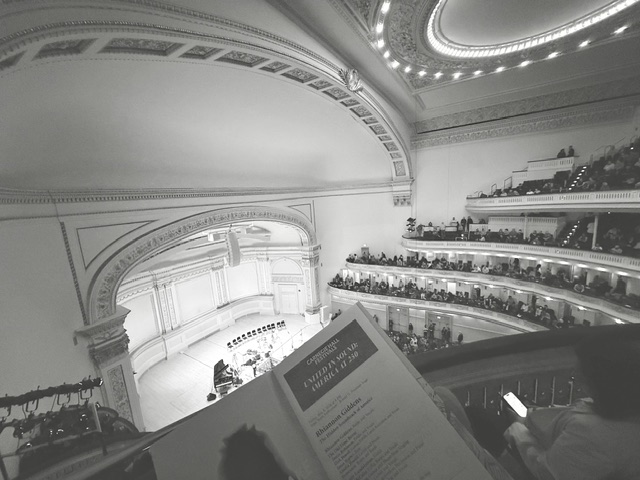
I try to get the same section, the upper balcony; up where the ushers grow quieter, the air grows warmer, and the sound arrives a micro split second later. Those seats are my favorite in the house. That is where I go to soar with the music instead of managing it.
So, there I was, in May, high up in the balcony, for Rhiannon Giddens and her band of musicians. And she blew the roof off Carnegie.
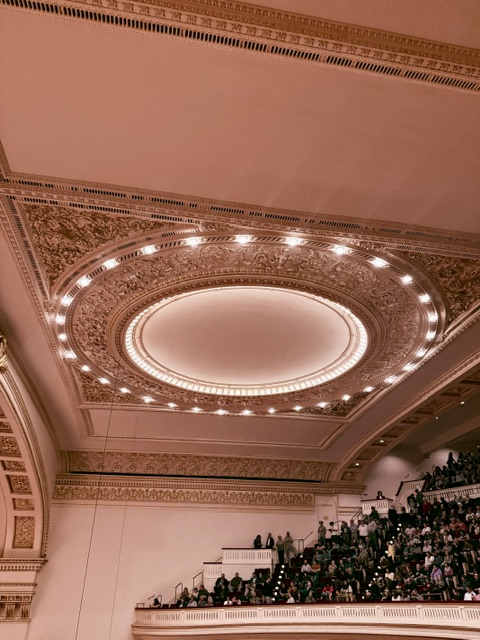
I mean that most genuinely. There is a beautiful, ornate oval set in the center of the ceiling above the stage and audience, and I have stared up at it a thousand times from the floor, the wings, and the back of the house while counting heads. That night, it spun open to the stars and another realm. We traveled with Rhiannon like spirits through time and the geography of America, through what was buried and what survived, through beauty and gathering, joy and woe. She was barefoot, wearing a dress woven for spinning. Beside her, a fiddler in a black suit, hair lifting as though gravity had negotiated different terms with him, began to turn as he played, a whirling dervish with a bow. She turned with him, and her bare feet came down thumping rhythmically on that stage, the same boards that have held over a century of music, and I swear the floor answered her back. The finale brought the whole house to its feet and sent zinging jolts through my body.
The spirits were dancing untethered that night, and I had no idea our ticket was super fueled for an adventure like that.
I woke up the next morning with the music still fluttering in my core, less the melodies than a space I had been enveloped in. The memories of the harmonies remained electrifying, and the feeling created swaddled me and wouldn’t let go. I hurriedly wrote to capture a short note before the day started and promised myself the longer version for another day.
This is that other day. It took a while to get here, and the reason is the second half of this story.
Something else happened that night, which has remained unsaid.
I came home and started writing the first lines of a story, which then spun into chapters. Those grew, whirling and unshackled like Rhiannon’s spinning dress.
A novel. Of all things. Not an essay or a memoir chapter, but a fictional journey, with a title that had been growing in my chest for years, waiting for an open door: The Muse. A classical concert producer, suddenly inspired to write a fantasy time-travel novel set in New York City. Within a week, I had a prologue: a young musician stepping off a plane with a leather instrument gig bag hugged to her chest, certain she would conquer this city. Within a month, I had chapters that not only traveled the city, but time, stories, and inspiration. The Met Museum’s Temple of Dendur with Ghosts and Spirits playing in the midnight panes of moonlight. The Village Vanguard in 1961 with John Coltrane spinning the Muse’s voice in jazz. Grand Central in 1944 with infamous Eleanor Roosevelt and a secret tunnel and a busking cellist. And at the pulsating core of it all, a night at Carnegie Hall with a barefoot singer and a spinning fiddler, when the panels in the ceiling above begin to breathe, then open, and a mother and her daughter rise through them in the hall, arriving on its opening night in 1891, white plaster, new wood, a room newly born that was just being asked to hold music and welcome the Muse.
The book has a line in there about what a portal looks like in the moment before it opens: the air remembering something, rippling and alive, just before a breath, held too long, is finally released with a whoosh, your heart rate thumping just a little bit quicker and deeper.
I will not give you more than that because the book’s chapters and journey are still spinning, and it’s not the point here. Where it came from is simpler: a ticket I bought.
And it came from Rhiannon and her musicians in that hall, doing the thing I have watched artists do for over thirty years and still cannot explain: not Performance, but Incantation.
The Muse is parked for now. The seeds are in the ground, and I know exactly where I planted them. I will return to them as bandwidth returns. I have learned, the hard way and more than once, that a seed does not need me standing over it.
Six weeks after that concert, at the end of June, Death entered my script. Suddenly. My business partner and friend of three decades, Jonathan, the man I built DCINY with, a classical concert production company, the one who conducted the downbeat while I counted heads. The bandwidth left the building that week, and it has been returning at a new and different frequency that I am still recalibrating to.
I have written about those days elsewhere, and I will again. In the first mornings after, when I couldn’t read or answer the phone, I kept returning to one piece of music. The same voice. Rhiannon Giddens, this time with Francesco Turrisi, singing They’re Calling Me Home. A song about sailing on, about missing the friends of yesterday, and about being called home. I played it and shared it with the people who cared about him before I could say a word.
I did not plan for that. I did not go looking for a Giddens song. It was simply the one that surfaced next to me, bobbing in the water like a float and providing me a place to gently, briefly, rest.
In May, she opened the ceiling, and in July, she opened the ground. Same voice, same season; the going out and the coming home. The spirits dancing overhead and the spirits calling from somewhere below, above and beyond. I think about this more than I care to admit and if you have read me for a while, you know my word for this: Godwink.
Jonathan and I used to say that DCINY beckons the muse and builds dreams for musicians of every kind. We said some version of that sentence to each other for as long as there was a company, almost two decades. I did not understand until this summer that I had named a novel after the same idea before I knew what this year would ask of me.
The muse does not care about your title, nor does she check whether you produced the concert or bought a ticket. As far as I can tell, she only wants to know whether you showed up and left the door propped open.
I think that is what Inspiration is, once you get past the poster version. A door left open in both directions; something comes in from the stars, and something goes out toward home, and the same music carries both.
Carnegie Hall turns 135 this year and that portal in the ceiling has been there all along. It opened for Tchaikovsky on the first night in 1891 and for hundreds of thousands of musicians who needed to stand under it at least once. It opened for a producer in the cheap seats in May, and it opened again, in a different key, for the same producer a few weeks later, sitting in her Upper West Side apartment with one song on repeat and chapters spinning on a laptop.
I will keep buying tickets, keep my balcony seat, and return for the seeds.
The spirits are still dancing and I can hear them from up here.
Has a concert ever opened a door for you? Tell me in the comments.
This piece first appeared on Camera Dark Notes on Substack.


Leave a Reply