25 years after a silent train, and what the back of the pack taught me about it
25 years ago this past Friday, September 11, 2001, the ordinary began as it always does, and then it did not. I was at my desk in midtown by seven in the morning. By the time I have a memory I can hold onto, I am in Grand Central in a sea of pale faces, some of them gray with ash, all of us wanting one thing. Home. I’ve written about that morning in Camera Dark, and on Friday I read a piece of it aloud at the Sober Sis retreat in Palm Springs, which is its own story and I told it in the companion piece under Camera Dark Notes (All of It). This is the other story. The one about the train.
The train was silent. Wheels, and the noise inside people’s heads. My husband Rob had left his cell phone at home that morning, a first in the history of Rob, so my calls went to voicemail again and again while I sat in a car full of strangers moving north, in roughly the right direction. I had to trust he was okay. I had to trust he knew I was. That’s the part that stayed with me. Not the smoke. The steadiness. Something in the forward motion of that train, the physical fact of moving away from the city and toward home, felt like its own form of prayer.
For 25 years I have been turning over one question about that train. Where the steadiness came from. How ordinary people, on one of the worst mornings of a generation, kept moving, held a door, gave up a seat, got home. Nobody built it that morning. There was no time. It was already in us. The crisis did not hand it to us. The crisis revealed it.
Two thousand years ago, Marcus Aurelius put it this way: what stands in the way becomes the way. For a long time I read that as a promise that each hard thing makes you someone new. A tougher woman, every round. I don’t think that anymore. Hard things don’t build me, they develop me. The tool was already in the drawer. The obstacle drags it into the light so I can finally see it and pick it up.
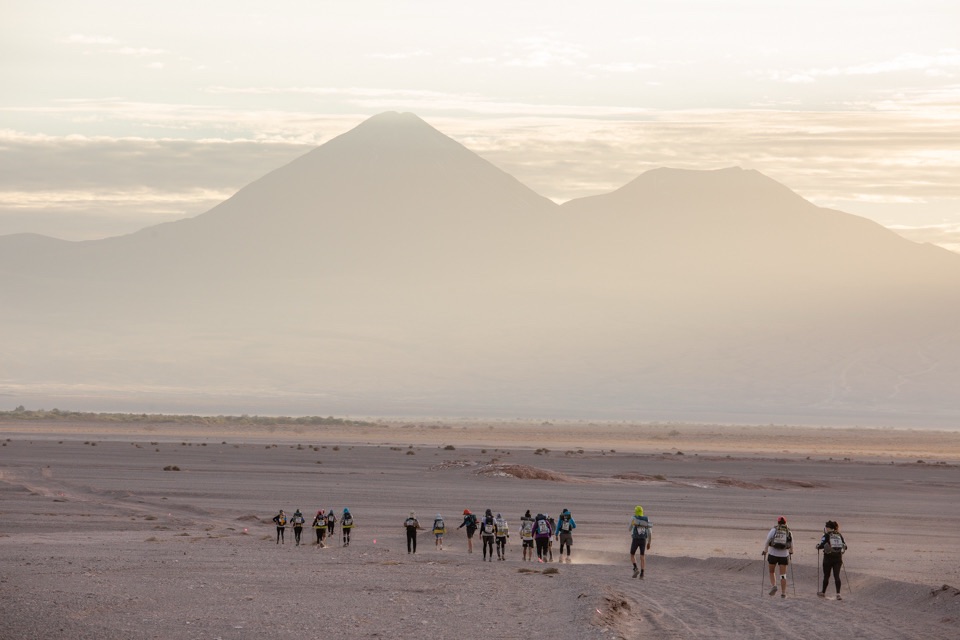
Anyone who has run from the back of the pack knows this in their legs. I have run four self-supported ultramarathons, 155 miles each over seven days, in Patagonia, the Atacama, Lapland, and Mongolia, and I have run eight New York City Marathons from the back, with the ninth coming November first. Not once did a race give me something I hadn’t brought. What every race did, without exception, was strip away everything else until the thing I brought was the only thing left. A tent in the Arctic Circle. The Mongolian steppe with nothing in any direction and the wind taking my breath before I could use it. Day four, when the feet are gone and the arithmetic of the day shrinks to Pocket Time: this ridge, this checkpoint, the next pink flag. I leaned on the trust I found on that train, the kind you cannot verify and can only hold, in every one of those places. Same trust. It was already there.
And not every round is a win. There is a race on my list with three letters beside it. DNF. Did not finish. I count it. The losses are exposures as much as the wins are, and sometimes they are the sharpest, because a loss shows you the tool you refused to pick up. My friend Pam has a word for this and I have stolen it with her blessing: brutiful. The beauty and the brutal together, only together, make the path.
Patagonia Pace is the name I gave the speed I can hold for seven days. Sustainable. Unglamorous. Mine. I did not invent it in Patagonia. Patagonia is where I found out I had it. Same with the back of the pack. I never chose it as a philosophy. I found myself there, mile after mile, and then noticed that the back is where the developing happens, because nothing is hurried and everything stays exposed for a long time. The front of the pack gets the finish line photograph. The back of the pack gets the whole roll of film.
There is a third place I have lived this out, and it deserves its own book, or at the very least its own Substack. Six years after that morning, Jonathan and I founded DCINY, our concert production company, and put on our first concert in January 2008 with no idea we were building something that would fill Carnegie Hall and Lincoln Center for the better part of two decades.
Nothing about the years since was imaginable from the desk I left in midtown that September. Not the brutality. A pandemic that emptied every stage we had booked. Landlords, lawsuits, a music library packed into boxes. Losing my co-founder without warning and finding out what I was carrying alone.
And not the beauty either, which I could not have pictured any more clearly than I could picture our daughter Ella, who announced herself the very next morning. Or the thousands of singers on the Carnegie Hall stage who had never sung in New York before. Composers who became family. A team of fifteen who kept the lights on when I could not see the switch. Each of those challenges asked for something I did not know I had, and each one found it, because it was already there. All of it, the brutal and the beautiful, brought me to this exact point. Here. Now.
New York City did not become resilient that morning 25 years ago. It was already resilient, and it took a challenge of that magnitude to show it. I have come to believe the same is true of any of us who look honestly at our hardest days. Whatever carried us through was not new. It was already ours. The light changed, and we could finally see it.
On November first I’ll line up for my ninth New York City Marathon, at the back, where I belong. Two years to the day since I took the drink out, which is the other darkroom and its own book. I won’t be building anything out there. I’ll be developing. Same legs. Same city. Same me. Clearer eyes.
It was already there.
Music for this one: the “Benedictus” from Karl Jenkins’s The Armed Man, with Sir Karl on the podium. It opens with a single cello and almost nothing else, holds there longer than feels comfortable, and then the choir comes in and the whole hall lifts. That is the shape of this essay and, if I’m honest, of the last twenty years at DCINY. Karl has been family to us for a long time, and his music has carried more of our singers onto the Carnegie Hall stage than I can count. Listen to the cello and wait. It was already there.
This essay first appeared in the Mental Laundry section of my Substack, Camera Dark Notes. Its companion piece is All of It.


Leave a Reply