Wynton Marsalis asked his musicians for belief with no cynicism. A review of a concert I never heard asked the same of me.
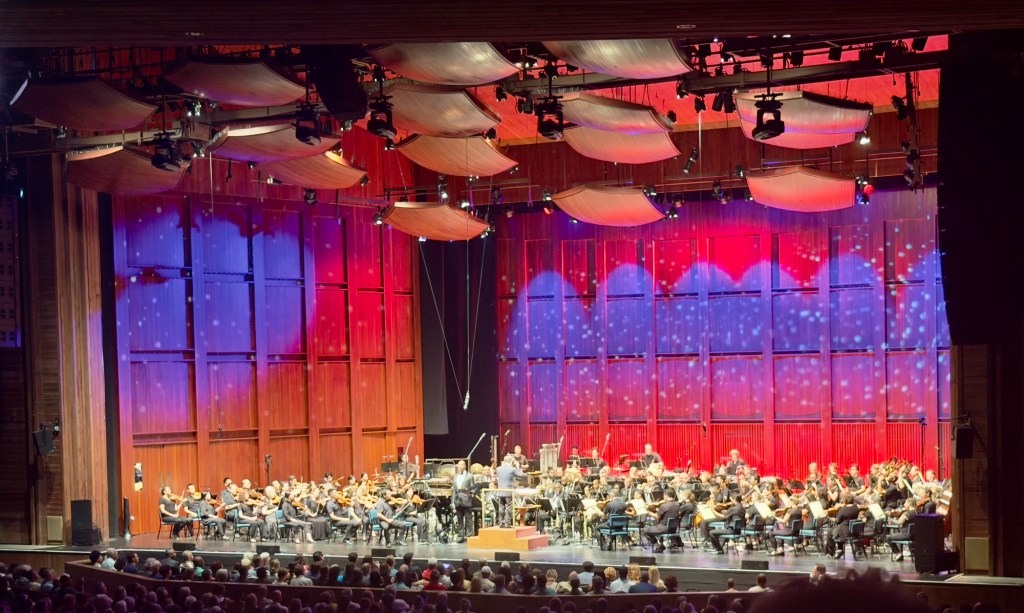
My sister Tessa performed as an oboist with the National Symphony this past weekend in the world premiere of Wynton Marsalis’s Fifth Symphony, “Liberty,” written for the country’s 250th birthday and scored for jazz ensemble with symphony orchestra. So, for a few days our family text thread was a running feed: news from rehearsal, a photo from backstage, and then the glow after concert night at Wolf Trap, still humming, nobody wanting to be the first to say goodnight.
I was not there. I was home in Manhattan on the Upper West Side, reading the texts as they came in, and then the next morning reading the New York Times review on my phone. That is when the thoughts started pinging.
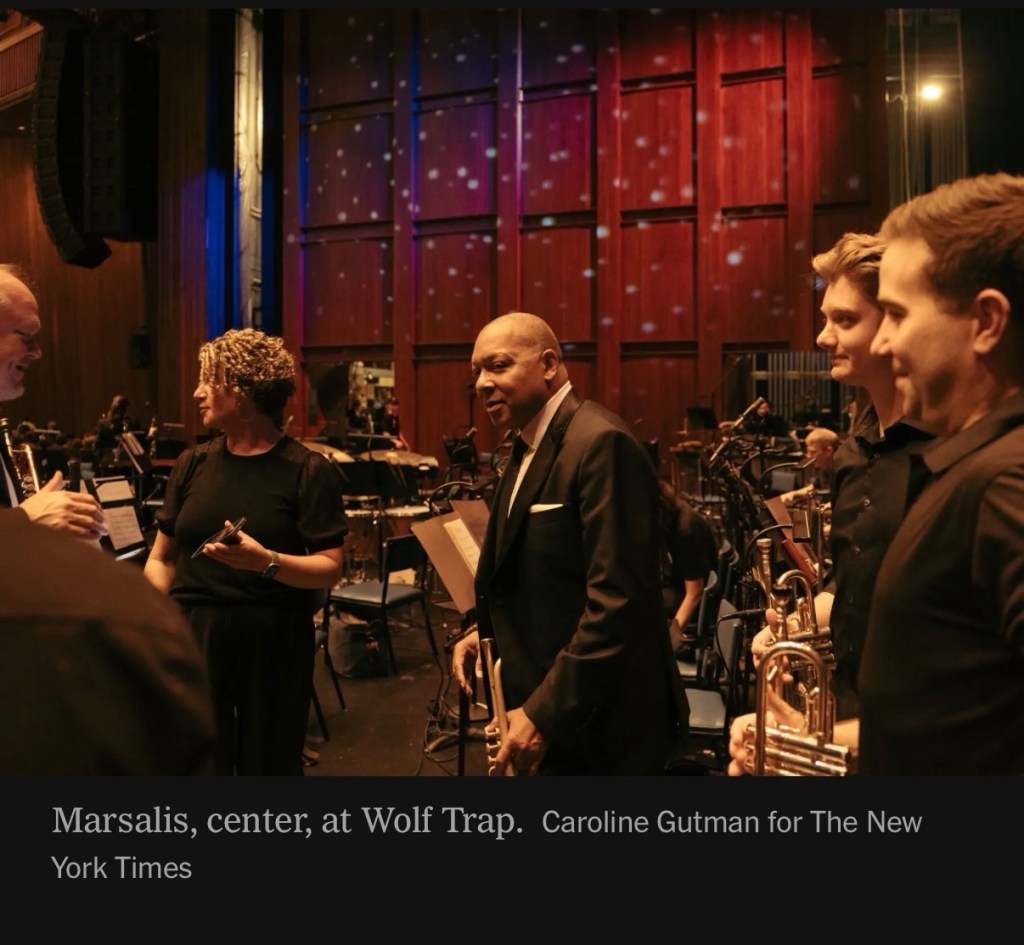
Disclaimer, then: I am a proud older sister. Tessa, an oboe whiz, is standing near Wynton (to his right) in the photo below, and she’s been thrilled about this gig since the first rehearsal. Slightly fangirl, too, at the gathering of powerhouse talents in that room. Somewhere in the printed interview, Marsalis wonders aloud how the oboe will be heard. Godwink and a woo-hoo for my sis.
The arts are important and, as often said, are storytellers vital to our world. They need to reflect our emotions, our journey, our concerns, even our feelings of hopelessness, and with those requirements, shine a light that we are not alone. They need to meet us when we are in distress and need hope, a light to show us the path forward. To reignite. To persevere. And to rediscover your strength.
Here is what stopped me as I read the Times review.
A movement in the symphony descends into purposeful chaos. Marsalis calls that section “Cacophony of Confederates,” and it is meant to sound like it: brass driving their own tempo, a singer in anguish, everything coming apart. Then a hard 12/8 groove takes hold, and everyone climbs back up out of the wreckage, together. In a New York rehearsal, as the band locked into that groove, Marsalis shouted to them that they were returning from the dead.
He stopped them a moment later to talk about what the end of the movement had to carry. It needed belief, he said. Like old people in church, the ones who just sit there, looking at you, nodding, yeah. That effect from the first note. Ultimate belief, with no cynicism at all.
Later, in his dressing room, he said it is part of why people call American music optimistic. That is what he is, with no evidence for it.
With no evidence for it. I have been carrying that line around for days.
I have spent a lot of years at the back of the pack, four deserts and eight New York City Marathons’ worth, and the thing nobody tells you before the start line is that belief does not arrive with the evidence. It has to be there at mile two, when there is nothing to point to. The evidence, if it comes, comes after, usually much after.
Sobriety taught me the same lesson in a different room. Year one, the days when there was no proof yet that this new life would be bigger than the old one, were only the choice to act as if. I named that season Camera Dark because a darkroom is not the absence of the picture. It is where the picture is made. You cannot rush the exposure. You stand in the dark and believe the image is there.
Then there is the cash register that did not ring. The reviewer describes it: amid the chaos and belief, right before the musical climax, the score calls for a ratchet and a desk bell to imitate a cash register, a small jab at supercapitalism, an old foe of Marsalis’s. In the final rehearsal at the Kennedy Center, the percussionists nailed it, and the staff in the hall laughed out loud. Two nights later, at the premiere at Wolf Trap, the bell mistakenly did not sound. Nobody laughed; nobody knew they were supposed to.
Here’s the irony you can’t overlook: the hall where that bell rang on Friday suddenly locked its doors this past Tuesday. The Kennedy Center is closed now. They say it will be for years, and the people who laughed in that room are now scattered. The cash register got its laugh in a building that money then shut. At Wolf Trap, it went silent.
I want to read that as a sign that supercapitalism does not get the last word, that the belief section is the one that survives. But the reviewer’s take is the truer one: future performances will have moments that shine. They are already scheduled, and they will go on.
For a back-of-the-pack writer, that is the whole sermon: You keep showing up until the bell rings.
This is also Marsalis’s final season as artistic director of Jazz at Lincoln Center, after nearly four decades. Two rooms the arts have relied on are changing shape at the same time, and I do not know what the future of the arts looks like from here. Neither does anyone else.
Which is, I think, the point. Belief is not the reward for evidence. Belief is what you bring into the room before there is any.
And that, I realize, is why I am writing this at all. I did not hear a note of “Liberty.” The sheer fact of its making, and a reviewer’s description of its themes and motives, lit my fire of curiosity and sent me down a rabbit hole of thought, and out of the rabbit hole came an urgent need to share. That is what the arts do when they are working. They tell the story of what is going on in our world, and the story does not stop at the last row of the hall. It travels through a text thread, through a review read on a phone, through whoever is moved enough to pass it on.
I understand my role in that chain more clearly every day. My muse pushes me to connect and to share, hence this piece. If reading about Wynton’s music sends one person to go find out more, and hearing it sends that person to tell someone else, then the bell rings. That is how it rings. With belief, and no cynicism at all.
“Liberty” travels the world to be heard, hopefully with that cash register bell ringing every time; to Cincinnati next month, then St. Louis and Berlin next year. Go hear it if it comes near you. I intend to. My sister will not stop talking about it otherwise.
Originally published on my Substack, Camera Dark Notes. Read more there:
→ Mental Laundry: Notes from the Back of the Pack. Four deserts, a decade of New York City Marathons, the back of the pack as a way of life.
→ Camera Dark Notes. From the wings and from the darkroom: leading, listening, concert stages, and sober-minded living. What comes into focus when the noise clears.


Leave a Reply