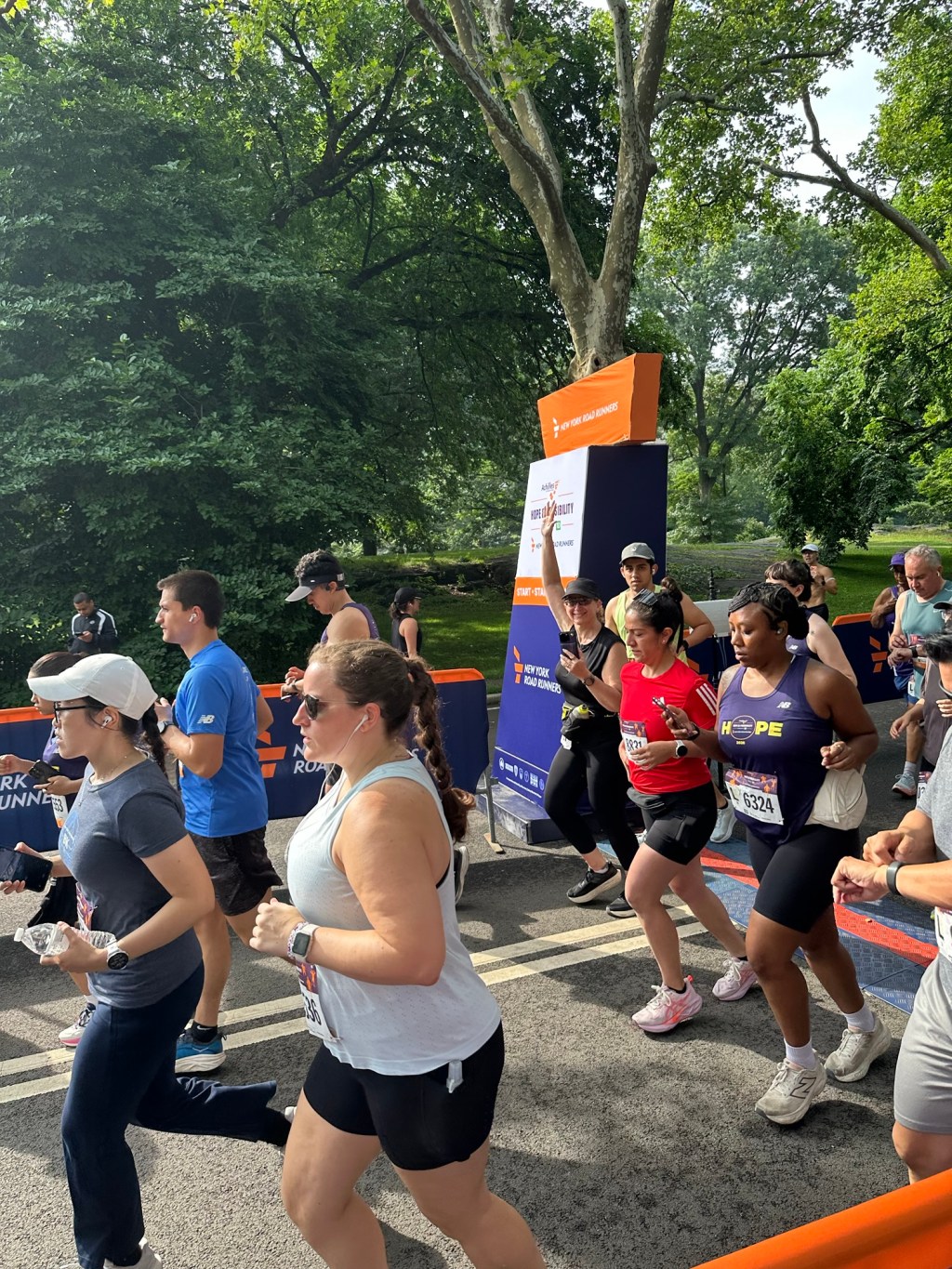
The Achilles Race had a name. It took me four miles to realize it was also an instruction.
“Blind runner on your left.” “Deaf runner coming through.” On a warm June morning in Central Park, the loudest voices at the Achilles Hope & Possibility 4-mile race belonged to the people clearing the way for everyone else. Ten thousand of us lined up that morning, hosted by New York Road Runners, and I didn’t yet know the runners around me were about to become my teachers.
Achilles International is a nonprofit that anyone who is active needs to know about; they pair athletes with disabilities with volunteer guides, enabling them to participate in mainstream racing (running, biking, whatever their passion is). They have been around for over 40 years and are built on a simple conviction that I think applies to everyone, no matter their ‘story’: that the course belongs to everyone. (This, coming from a back-of-the-pack journeyer.) Today, Achilles guides ran alongside, supporting runners who carried disabilities: some blind, some deaf, some running on blades, some on the spectrum. They made room for them and announced what the runner could not.
You hear it again and again over the course of the morning, before you ever see the bright fluorescent green Achilles shirts: the guides announcing. Loud, purposeful, non-negotiable, and repeated as often as the course demands. Kind but relentless, firm in the task of supporting their runner, they clear the way confidently with words, making room for the possibility of the path ahead.
I found myself thinking: what if we had guides like that in daily life?
Join me for a moment and imagine: “Caution, this runner didn’t sleep well last night.“ Or “Excessive hangover coming through, keep the volume down.“ Or supporting my single friends, NYC Tinder style: “Bad date last night, much disappointment and loss of hope coming through, make room and be supportive.“ Wouldn’t we all be more patient and make more room?
Because the truth is, we all carry hopes and challenges, especially challenges that no one around us could possibly imagine. Particularly the ones that aren’t visible and that we haven’t yet been given language for.
Here’s what I’ve been sitting with since the finish line. The race had a name, and it took me four miles to understand that it was also an instruction: HOPE is not always enough. You need to know what POSSIBILITY exists, or at least the direction of it. And in between those two words, you need to do the work.
HOPE without possibility is just wishing.
POSSIBILITY without hope is a map with no reason to move.
The runners around me today were carrying both. For many, this was their first race. The NYC Marathon in November shimmering on the horizon. That race is a party like no other, winding through all five boroughs of New York City, and today’s 4 miles was perhaps one more step towards that Willy Wonka golden ticket of an adventure. I talked to them. I admired their hope and blew on those embers gently, making them glow, encouraging them as their excitement lit something back up in me.
Because that’s how it works. Unless you voice your HOPE, whether internally or externally, you cannot find the possibility. If you want a guide running next to you, if you want to accomplish something extraordinary, you’re going to have to let yourself be seen. We are not that far from each other in this.
Around mile 3 near the Jackie O Reservoir, I encountered guides accompanying a runner on the spectrum, counting down a running interval loudly so that the goal, the endurance, was broken into something reachable. They shouted the numbers loud enough for the whole field to hear. Thirty seconds at a time running, and then a break to walk. And everyone surrounding them joined in; we couldn’t help it. 30. 29. 28. Like New Year’s Eve, right there on the course. When the countdown hit zero, she slowed to a walk, her face lighting up with the accomplishment, and the whole field around her cheering. Then it began all over again. Hope and possibility interlocking and supporting all of us, united through her challenge. She had no idea how much she was inspiring the rest of us in return.
The man with two blades for legs pushing his daughter’s baby stroller. Her legs kicking joyfully in the wind, supporting her father’s quick pace as she yelled out “Faster! Faster!”
The runner who is blind, well known on social media, surrounded by a particularly large Achilles entourage of guides. I’ve seen him at NYRR races before. His words about life and philosophy, the world seen through senses other than sight, always draw people close. The guides surrounding him today weren’t just guiding; they were choosing to be near something. The buzz of deep conversation and connection was like a magnet, drawing the group surrounding them ever larger.
Here’s my confession: I told myself I would run this race beginning to end and not walk and not stop, and instead I’m doing exactly what I’m doing right now, breathless from running and “caught in the act” as I slow down to speak into my phone’s notepad, writing, thinking, being inspired, and sharing. But I digress. I accept. I knew I would and won’t pretend to be surprised.
Because running sparks my mind, and it gushes forth with words, stories, and ideas. I empathize with John Milton, the blind poet who composed Paradise Lost entirely inside his head. He could not see the page nor hold a pen to record his words. He would lie awake turning verses over in his darkness, then wait for his secretary to arrive every day so he could, as he famously put it, be “milked” of all those words. Every masterpiece memorized first, written in the mind before it ever touches paper.
I am not Milton; but I understand the urgency and the need. If I don’t capture these words before the endorphins wear off at the finish line, I risk my mind erasing its giant chalkboard of thoughts, gone blank in the moments post-race.
So I capture them. That’s the deal I’ve made with myself. I allow myself to make an audio and/or text record or scribble in my tiny notebook, hoping it will make sense later in the day when I try to decipher the misspellings and garbled text. It’s a bevy of symbols, an alien language that sometimes needs a Rosetta Stone or a cryptograph to translate. But that’s sometimes the fun of it, as ideas need time to grow, and in translation, I often find another layer. My yellow notebook from 4 ultra marathons has left me doodles and symbols that are birthing two books, so I honor the process and don’t question the need anymore.
My own reflection on the power of possibility brings me to a thread I keep returning to: sober-minded living. It began small: a 21-day reset in November of 2024, no drinking, after I finally admitted to myself that something didn’t feel right. That one honest admission opened a door — connections, people, tools I hadn’t known were there. But a door is only a beginning. One step is never enough; you have to continue your steps and keep walking through doors that appear. The possibilities I couldn’t imagine on that first day are becoming real now, some tangible today, some still dreams with direction.
That is why the new runners undid me a little today. So many of the ones I saw were lacing up for their very first race, and it made me overjoyed. Because I know that start line very well. I have stood at that kind of beginning myself, at the edge of something I couldn’t yet see the shape of, carrying hope and no map.
What I wanted to tell every one of them is what I wish someone had shouted loud enough for me to hear: this was never just about the sneakers. You have voiced the hope. Now do the work, and the possibility will come running up beside you.
We are all somewhere on the same course. Some of us at mile zero, some near the finish, all of us needing the way cleared with a few loud, generous words. Hope and possibility, and everything we are willing to do in between. That is the race. It always was.
If this resonated, here’s my ask. Leave a comment below and tell me where you are on the course — mile zero, near the finish, somewhere in between. And if it moved you, share it with someone who needs the way cleared today.
The fuller body of this work lives on my Substack, Camera Dark Notes — essays on sober-minded living, running, and what clarity reveals. If you’d like the next piece to land in your inbox, subscribe there. There’s a free option, and a paid one if you want to help support the work. Both mean something.
I want to meet more of you. Tighter circles, not wider and thinner ones. Let’s show up for each other. That is the deal.
→ Camera Dark – a memoir in progress about sober-minded living and what the dark room reveals.
→ Mental Laundry – notes from the back of the pack, across four deserts and nine NYC Marathons.


Leave a Reply