What losing my hearing taught me about listening
Battery low.
That is what the voice in my ears announces, sweetly, from inside my own head, when my hearing aid batteries are about to quit on me. A gentle woman’s sing-song voice. Just for me. Nobody else can hear her. The miracles of technology.
Which is why, the first dozen times, I replied to her immediately and out loud, as if she were standing right next to me: “BATTERY LOW!” I bellow it back like a fan at a soccer match, to a room of people who had heard exactly nothing and are now startled as I shout two words at the ceiling. (My family has since learned to translate: Ah. Mom’s hearing aid batteries. Carry on.)
I am a flutist. Classically trained. And a concert producer. I have spent my whole life inside sound… breath moving through metal, vibrations, the acoustics of a room, the half second before a hall goes silent and a thousand people lean in together. Sound is the canvas of my life.
And I am deaf, well, losing my hearing.
I say that lightly now. It took me years to say it at all.
Here is the part people don’t understand, so I will say it plainly: it is not that I cannot hear you, so please, PLEASE, do not just repeat it louder. Or worse, yell. It’s the COMPREHENSION. The sound arrives. It just arrives scrambled, a word or two swapped out, and my brain, ever the optimist, fills the gaps with whatever it has lying around. That usually means something absurd, sometimes something better than what you actually said. And I will run with it. Confidently. For blocks. I have learned over the years to “fake it ‘til I make it” and bullshit hard. I’m a master, honed by need.
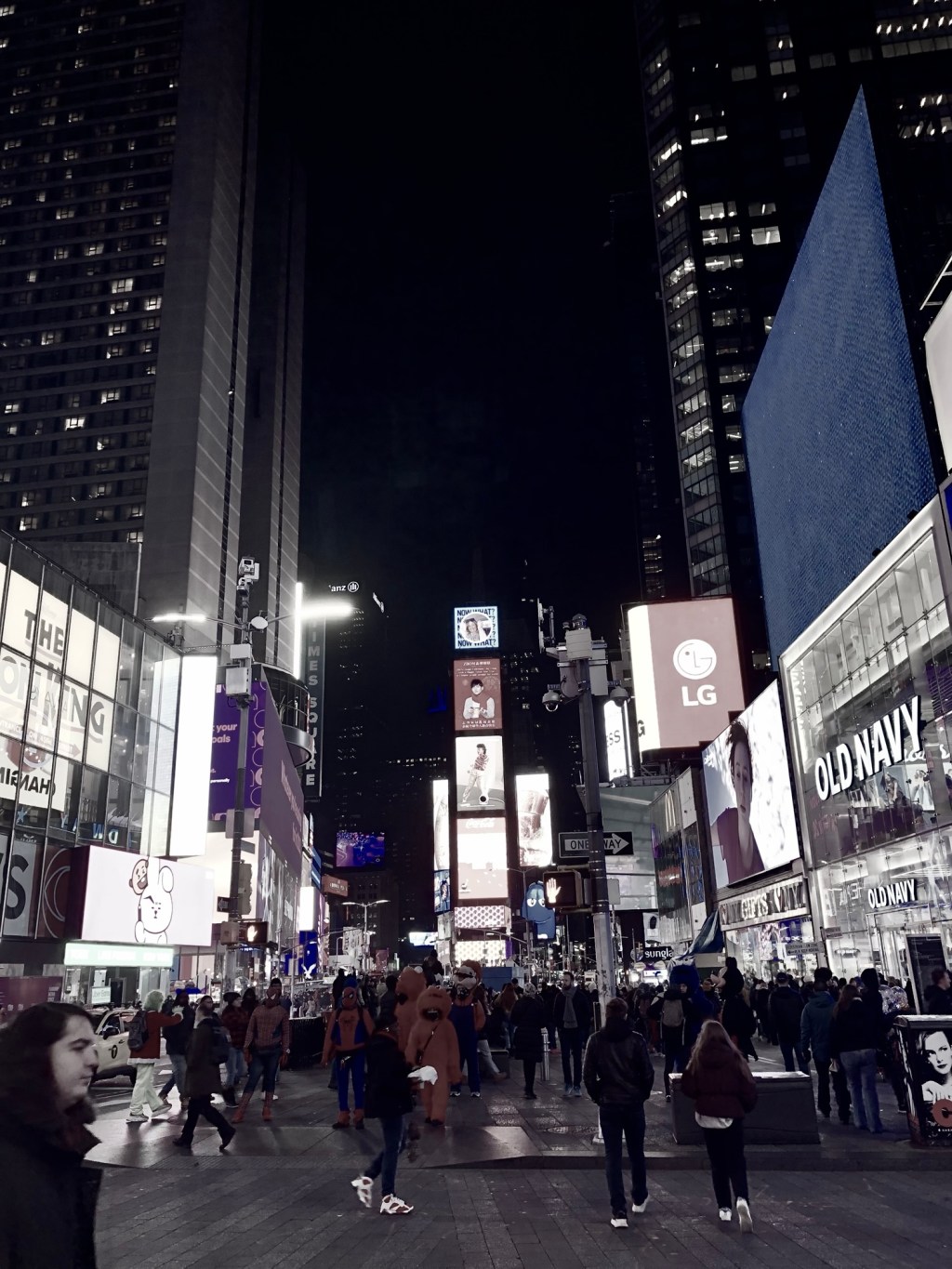
Which brings me to my daughter, and to 42nd Street, Times Square, on a very packed afternoon (when is it not?).
The TickTokers
Ella and I are people watchers. Professional grade. Give us a crowded corner of this city and we will narrate the whole passing parade… the tourists moving like a blockade, schools of fish that refuse to part for you, the vendors with endless goods spread out on blankets, the guy in the slightly battered full Elmo suit taking a smoke break, his head held under the crook of his arm, the woman power walking in heels most of us could not stand up in (oh, it’s not a woman… that’s another story).
So, we are threading our way out of Times Square, zig and zag, serpentine, and Ella leans in and says, “Did you see those TikTokers?”
TikTokers. Yes. Obviously. Influencers, I think. Someone striking a pose for the camera. I nod knowingly. I did catch a great deal on our little journey. I am already sorting my mental file of who qualified for this comment.
Then she says something about them eyeing OUR bags.
And I pause and immediately say, “Why?”
(I mean, honestly, why would an influencer, a TikToker, be looking at our bags?)
Cue the eye roll, the daughter kind, the one she has been perfecting since she could roll them. “Because that’s what they DO,” with a long lean into the “Dooooooooo,” to then, quietly, devastatingly, imply the word ‘duh’ attached to the end of it. Not spoken but felt, which is how I knew for certain we were now having two completely different conversations in the middle of the busiest sidewalk in America.
“Say it again?”
“Did you see those PICK POCKETERS?” (yes, she did yell it this time, but will blame the roar of Times Square and not her exasperation with her mother).
Oh, (I think) Pick Pocketers. Not TikTokers. Thieves. She had been warning me about crime, and I had been mentally curating an entire lifestyle content photo roundup, New York City-style.
We laughed for blocks. Actual blocks. The kind of laughing where you have to stop and hold onto a scaffolding pole and let the crowd flow around you like water around a rock. (Pick Pocketers would have had a field day. We were defenseless.)
I have a hundred of these moments. Highs and lows go first when your hearing goes… the top of the piano, the sirens, the S sounds, the small consonants that do all the quiet work of meaning. So, my life is quietly, constantly being rewritten by a bad transcriptionist who lives in my ears and means well.
Shortie
Here is what happens on a good day, when I remember to reach for the tool.
I was thinking about downsizing the company’s office footprint, out with my broker to see a smaller space in midtown, the kind of right-sizing that feels a little like admitting something. We were waiting in the lobby for the landlord’s rep.
And a very short man came flying in, late. Handsome, beautiful suit, cufflinks catching the light. Oh, and sneakers, but no socks. Somewhere between “I did not pay attention when I got dressed” and “this is a cool new look, and you will all be copying me by fall.” (I could not decide which, and I admit I loved him a little for the ambiguity.)
He locked eyes on us, changed course, and I understood immediately that he was the man with the keys. Petite, maybe four foot six, I was measuring him against my tiny sister-in-law for scale. His hand shot out a full three feet before he reached me, and he said, bright as anything, “Good afternoon. I’m Shortie!”
And then it happened. The Iris pause. The silence of a sentence being run back through two hearing aids and one extremely overactive imagination that adores comedy. Surely not. No, no, NO(!) Iris. Surely this man, all four foot six of him, in the cufflinks, did not just introduce himself as Shortie.
Every old instinct I owned said: smile, shake his hand, say “lovely to meet you,” and never speak of it again. Bullshit my way through, master that I am.
But I have new instincts now, afforded to me by the dual hearing aids and a new rulebook for making my way through life. So, I asked him, before I could embarrass us both, to say it again.
“Jordie. I’m Jordie. Sorry I’m late.”
Of course, Joooooorrrrdieeee, not Shorty, now understood. I shook that man’s hand, and I have never been so grateful to my own bad ears and to one small question. And Jordie, it turned out, was warm and funny and quick on his feet, the kind of guide who makes an office tour fly by. By the last floor, I had half forgotten we came for the real estate.
In all Polish
I hope I have conveyed by now that I am fluent in mishearing and accept it. But I have a second specialty too. I am an expert in the errors that machines make on my behalf, the ones most people never catch, because they never have to look.
I live in closed captioning. Transcripts, auto captions, the little text crawling along under everything. And I have learned the secret that the hearing world mostly misses. The captions LIE. Confidently. Constantly. Exactly like my ears.
A friend sent me a recorded video message not long ago. Warm, ordinary, something about the weather and an afternoon out with friends. And the transcript arrived, which I read first… entirely in Polish. She does not speak Polish; I do not speak Polish, but there it was. Her tender little hello, rendered faithfully in a transcribed language not one of us possesses.
And then there is the cursing. The machine loves to sprinkle it in for flavor. A friend will be telling me, sweetly, about her walk and her lunch and the lovely light, and the transcript drops in a “penis” here, a “f*ck” there, like confetti. Sprinkles on a note about the weather. I know for a FACT she did not say these things. She would never tuck an obscenity into a story about her salad. So, I sit and laugh, imagining the alternate friends the machine has invented for me, cheerfully cursing their way through a Tuesday.
It keeps my imagination well fed. But it does something else too. It keeps me SHARP. When you cannot fully trust the transcript, or the captions, or your own ears, you learn to sift. To hold everything a little loosely. To ask, wait… does that actually make sense? Would she really say that?
And that muscle turns out to be useful everywhere. The news does exactly what the transcript does. Half heard, half right, delivered with total confidence. Social media, most of all. ESPECIALLY social media. A firehose of the certain and the false, moving too fast to question. I spent years learning to sift my own life for the true signal buried in the scramble. Turns out that was just training for the whole information age.
I do not take much at face value anymore. My ears taught me that. Call it a gift. Wrapped in Polish, with a curse word tucked inside (and anyone who knows me knows how much I love a good string of curse words).
For a long time, I found all of this humiliating. Now I find it hilarious. That shift is the whole story, really. But it did not happen on its own.
The glasses
Here is the thing. I wore the hearing aids the moment I got them. No hesitation, no drawer, in they went. So, this is not a story about denial.
It is smaller than that, and somehow bigger. Because a few days in, I said something to my husband, Rob. Casually, almost a throwaway. That I might not wear them EVERY day. Just when I needed them. Meetings. Concerts. When I decided.
As if the hearing loss took days off. As if the world would kindly speak up on my behalf.
Rob is my husband of over 32 years. A jazz musician and a man who spends his days leading a school for students who are blind, so he knows a thing or two about what tools do and do not mean.
And he said it simply, without any heat in it:
“You wouldn’t NOT put on your glasses in the morning. So why would you say you won’t necessarily wear your hearing aids every day?”
Oh.
I did not have an answer. Because there is not one. My glasses are not a confession. They are not an apology. They are not a small daily admission of defeat that I make to the bathroom mirror. They are just how I SEE. I put them on the way I put on the day.
So why had I decided that the things that let me HEAR were somehow different? A weakness to be rationed. A secret to be managed. Rob’s blind students would give anything to slip on a pair of glasses and suddenly see. Why was I resisting the ones that let me hear?
Stepping stones
I have written before about tools. About the lifeboat of people, “your people,” about the things we grab hold of to stay upright in the churn. I keep returning to this idea because I keep needing it.
Accepting tools has been the quiet spine of my whole life. Sobriety was a tool. Running was a tool. The people who held me up when I could not hold myself. I resisted every single one of them at first, because I had somehow absorbed the idea that needing help was a lesser way to live.
That kind of thinking is exactly backward.
The tools are the stones you step on to cross a raging river. You do not apologize to the river for using the stones. You do not stand on the bank insisting you are strong enough to swim it, and then drown politely, with dignity. You find the stones. You trust your weight to them. You cross. One step at a time.
The hearing aids were just one more stone I had been refusing to step on.
What the stone gave me
Here is what nobody warns you about accepting the tool. It gives you back more than it costs you.
Because the aids came with something I did not expect. Not just sound. PERMISSION. Permission to say the thing out loud. I didn’t catch that, could you say it again. I’m going to need to sit on this side. Hang on, let me get closer.
Just a few words: I didn’t catch that. One more time.
I would rather have nodded along, smiled, guessed, and gotten it wrong (see: pick pocketers) than admit I had missed something.
The nodding-along was the real disability. Not the ears. The pride.
And the strangest thing happened when I started asking. People leaned in. They turned toward me. They slowed down. Conversations I would have half heard and let float past became real. The asking, the honest admission of “I need a little help here,” did not push people away. It pulled them CLOSER.
Every time. It turns out that letting someone help you hear them is one of the most intimate things you can offer a person. You are saying, “What you have to say matters enough that I refuse to fake it.”
The listening
There is an irony here that is not lost on me. The flutist, the musician, the concert producer, losing her hearing.
But I will focus on what that challenge has taught me about listening, and it isn’t what you would guess; when you cannot rely on catching every word, you start reading everything else: the face, the hands, the lean of a body toward you or away. The pause. You listen with your whole self because your ears can no longer carry the load alone.
I hear less now. And I pay closer attention than I ever did when I could hear everything for free.
Superwoman
In the early days, putting the hearing aids in and all that was required with batteries and cleaning was a whole production. It required silence. A cleared surface. The kind of unbothered focus you would give to defusing something, all of the pieces laid out like a mini ticking bomb. Each tiny step, intentional and careful. (Now I do it like swallowing my morning vitamins. Eyes closed, barely awake. But not then.)
One morning, my niece Liana wandered in, eight years old and made entirely of questions, right as my ritual was getting started. And because I am a born educator, a sharer, an artist who cannot help but narrate, I waved her in close to show her everything.
I built it all up and made it marvelous. Partly so this little girl would never be afraid of the machines in her aunt’s ears. And partly, I will admit, to drown out the other voice, the one running quietly underneath, the one saying “Iris, you are old, you are falling apart, look what you have come to. Boo hoo me”.
So, I told her the truth, just a braver version of it. “Liana,” I said, “these make me a SUPERWOMAN. I can hear everything, everywhere.” And I showed her the little microphones that pick up sound from every direction, how I can aim them, how, with one click, I can answer a phone call or pipe in music, and no one around me has the faintest idea.
Her face. The pure wonder on her face. I kept it.
Fast forward a few years. I am back in the old mode. Feeling old. Feeling like I am coming apart at the seams. And that sweet traitor voice in my ears is bellowing BATTERY LOW, and my spare batteries are, of course, nowhere near me.
Liana is there. She sees my face and asks what is wrong. And I tell her, a little defeated, that my hearing aids are dying.
And she lights up. Absolutely lights up. “Oh! Iris! SUPERWOMAN!”
That was all it took. My own words, handed to an eight-year-old years earlier, boomeranging back to land exactly where I needed them. She had not seen a woman falling apart. She saw the superpower. She believed me. And in believing me, she made it true again.
And I stood there, dead batteries and all, the luckiest woman in the room.
Tomorrow morning I will put them in the way I put on my glasses. No ceremony. No apology to the mirror.
And sometime in the days ahead, a small kind voice only I can hear will announce, to me alone, that the battery is low.
I already know what I am going to do.
I am going to bellow it right back.
If you have ever misheard your way into a better story, please tell me in the comments. I collect them! And isn’t laughing together better than laughing alone?
Originally published on Camera Dark Notes, my Substack newsletter.


Leave a Reply